It is insufficiently known that when asked, patients are very willing to share their medical information with researchers but much less so with public health authorities or third party companies. It is therefore ironic, that whereas the latter two groups do not require institutional review, researchers do. Moreover, if a study pertains to a set of patients seen at different institutions, the researcher will first have to obtain review from the institutional review boards (IRBs) of each one of the institutions. For a variety of reasons there is significant inertia working against getting one IRB to cede review of the study to another IRB. For this reason, this draft policy from the NIH is a welcome potential accelerant of biomedical research. If it is ratified, this policy will ensure that a single IRB for these multi-institutional studies becomes the rule and not the exception. A seemingly fine point to those who have never had to organize a multi-institional research study, but it might do more to advance medicine than hundreds of millions of dollars in additional research funding.


2014-03-27
Classification system worthy of legislative intervention?
The ICD-10 diagnostic classification system is due to be adopted by US healthcare systems this year. However, new legislation would defer that change by at least a year. Who would have thought that a group of statisticians working on a list of the causes of death in 1891 would cause billions of dollars to be spent and thousands of hours invested in debating what that list should look like?
This fine system of classification that would have made Linnaeus’ head spin includes classic diagnoses such as:
V91.07xD (burn due to water-skis on fire, subsequent encounter)
W56.22xA, (struck by orca, initial encounter.)
W56.12XA (getting struck by a sea lion)
V97.33XD (Sucked into jet engine, subsequent encounter)
The orcas may have to wait another year before getting their medical recognition.
2014-03-25
Achieving clarity in cancer genomics
Approximately 3 years ago, we held a clinical bioinformatics summit to discuss with international leaders in genomics, genetic testing and clinical laboratory procedures what it would take achieve clinical grade whole genome sequencing (WGS). That is to make WGS a safe and useful component of routine diagnostic assessments in the clinic. Among the mechanisms we chose to accelerate the advent of clinical grade WGS was a competition where 3 families contributed their genomic sequence and clinical histories. Then multiple teams assembled and competed to produce the most accurate, most clinically useful diagnostic report. The competition resulted in a lot of learning and multidisciplinary team formation but also, even though we had not dared count on it, several breakthrough diagnoses. A good lay summary can be found here from Bio-IT World and an in-depth scientific summary here. Also, the cake presented by one of the mother’s to her child, who had gone for years without a diagnosis until the leading teams converged on the same mutations in the same gene, is shown below. With generous funding from Rob and Karen Hale, we kicked off the next round of the CLARITY competition as described below.

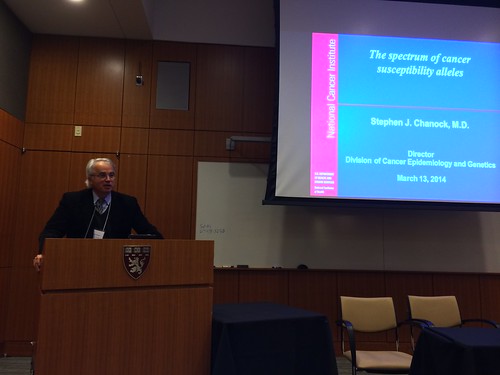
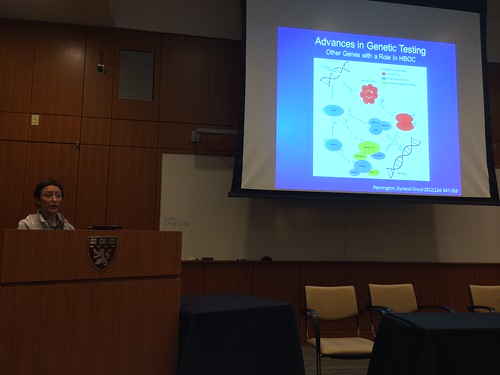
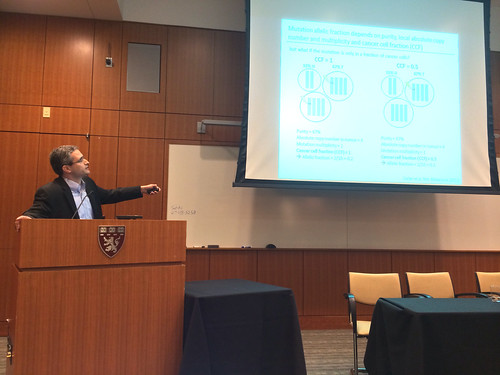
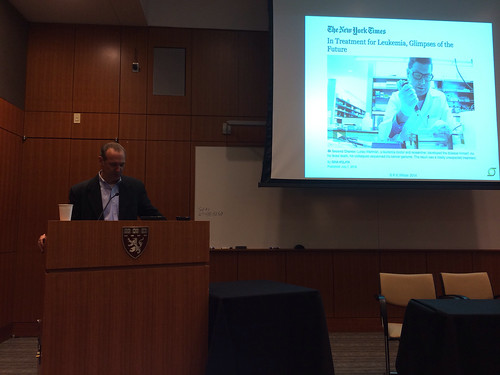
In addition to rare undiagnosed diseases, perhaps the most clinically impactful area of genomics, in the near term, is that of precision diagnostics for cancer. However, the analytic challenge is far deeper as it requires analyzing tumors that are often heterogeneous (i.e. different clones), comparing it to germ line sequence (i.e. non-tumor DNA). Then, how are we to determine which of the mutations found are relevant to the diagnosis or therapy selection? Integrating information from RNA sequence and epigenetic modifications (e.g. DNA methylation) may help and there are several good ideas being proffered by several researchers. Yet, how do we begin to bring all the data together systematically and meaningfully for patients with a malignancy? Given how early we are in this new realm of medicine, we decided to first hold a workshop where several national leaders in cancer genomics gave thoughtful assessments of the best way forward. After we we synthesize the learning from this meeting, we will announce a new CLARITY challenge for patients with recurrent cancers. Shown below are some of the speakers at the meeting which included Gad Getz, Rick Wilson, Peter Park, David Sweetser, David Margulies, Isaac Kohane, Judy Garber, Sharon Plon, Steve Chanock, Marian Harris, Heidi Rehm, Levy Garraway, and Katie Janeway. Another small but important step forward in the development of a data-driven, computationally-enabled medicine.



2013-04-08
Getting Big About Mapping Dengue
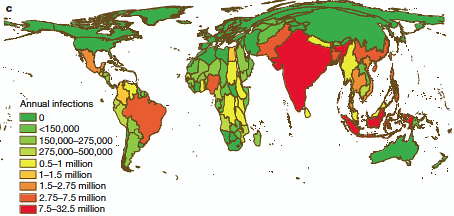
Here's a very nice application of lightly used data sources about Dengue, a scourge of underdeveloped countries. As in so many areas of public health, this huge health burden is woefully under-documented. In the absence of a vetted vaccine, understanding where it is endemic is essential for the application of scarce preventive resources. This group of investigators have cleverly used a number of public but under-used data sources, including the published literature, to create a predictive map of where 390 million infections per year are occurring.
) 
2012-12-03
Take this ontology and shove it. Or, why classification matters.
I was recently called out by one of my colleagues for saying that ontologies were boring, this despite my own doctoral work on knowledge representation. Motivating my glib comment was an image of a group of pasty-faced individuals gathered around a large boardroom table and discussing which angel fit on which pin. Events from this past weekend are a reminder why such glibness is not helpful.
The American Psychiatric Association has just approved a set of updates, revisions and changes to the reference manual (DSM5) used to diagnose mental disorders. Among the changes are those redefining the inclusion and exclusion criteria for autistic disorders. By changing which children are classified as having an autistic disorder, parents will be made to feel more or less comfortable having a child carrying the diagnosis. Just as importantly, insurance companies and school programs might shift their criteria that determine which child and family gets what kind of support and at what cost. In the near term, clinical trials for the treatment of autism may not include the same patients as they would have prior to this retaxonomization.
So, are ontologies boring? Perhaps. But they certainly belong to the class of hugely important societal constructs.
Hat tip: David Osterbur.
2012-08-16
Hungry for DNA Games?
Thirty teams world-wide are apparently hungry enough and willing to contribute to making genomic medicine possible. Their efforts will help reduce to practice a game that to date is only within reach of star teams. May the odds be ever in our favor.
2012-06-13
Dearth of Death: A Fatal Wound to Medical Research?
My esteemed colleague L.J. Wei often reminds us that health outcomes which are not as hard-edged as death can be misleading. For example, the early press, decades ago, about the uncovering of early cancer by the Prostate Specific Antigen (PSA) was used to justify the surgical removal of hundreds of thousands of prostates. In hindsight, neither the PSA test nor much of the ensuing expensive and occasionally morbid surgeries made a significant dent in lifespan.
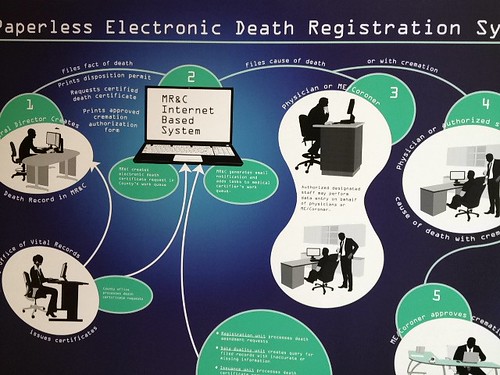
One might therefore reasonably conclude that the government, the census bureau, Social Security Administration or the Department of Health and Human Services would therefore place the highest premium on the accurate reporting of death, and its causes, for our citizens. Surely, those data are the incontrovertible evidentiary base for our public health monitoring, medical treatment evaluations (whether of drug, device or procedure), and projections of the fundamental demographics of our nation. So, it might be all too easy for most of us to overlook or dismiss the following innocuous-appearing bureaucratese-laden announcement
IMPORTANT NOTICE The National Technical Information Service (NTIS) has been notified by the Social Security Administration (SSA) of an upcoming important change in the Death Master File data. NTIS, a cost-recovery government agency, disseminates the DMF data on behalf of SSA. Please see the attachment, provided by SSA, for an explanation of the change. The implementation date of this change is November 1, 2011. Should you have any questions, please email me at wstrickland@ntis.gov and I will be happy to forward any questions not answered by the attachment to the Social Security Administration for reply.
What does this mean? It means that there is no longer a single, federal authoritative source of death records. Most of the operational details have now devolved to individual states without guarantees of consistency of reporting or a one-stop-shop for researchers looking for the national distribution of the Grim Reaper. Will we have to resort to crowd-sourcing death now in order to perform accurate population research?
Hat tip: Shawn Murphy
2012-03-21
The passing of clean taxonomies.
Among the most productive constructs of the enlightenment are the modern taxonomies. These have been helpful in bringing order to the chaos of signs and symptoms and other clinical findings and were central tools in achieving our 20th century understanding of pathophysiology. They have also have an influential role to play in reimbursement for medical services. With the dawn of high-throughput molecular diagnostics many of us recognize that we are going to be able to be far more precise in our diagnostic and therefore therapeutic approach to diseases and their prevention.
Nonetheless, as we approach the systematization of medicine, we will be reminded often that nature may not hew to the simplified models that we are developing. This recent study in the New England Journal of Medicine, just does that by demonstrating directly that within a "single" tumor there exists a large multiplicity of tumor types, each with its own genomic characteristics and therefore particular therapeutic responsiveness (or lack of it). It can be argued that this is another instance of the tension between the "neats" and the "scruffies" but perhaps it is a foreshadowing of the decreased effectiveness of taxonomies as a cognitive tool for biomedical discovery and clinical care. If indeed, the underlying substructure of physiology is best represented by a probabilistic network model that can only be best grasped and managed through the use of computational tools, we have to seriously re-evaluate both our approach to disease definition and biomedical education.
2012-03-01
Get paid to play
Earlier, I described the SHRINE distributed query system across 6 million patients with 10 billion facts. If you are a member of the Harvard Medical School faculty (with employment at one of the affiliated hospitals) you now have the opportunity to get money and glory (more the latter than the former) to spin clinical data into biomedical gold. Details on the context can be found here: http://catalyst.harvard.edu/services/pilotfunding/shrine.html
If you have questions, use this email contact.
2011-12-14
Alternative Senior Rounds 2011
Let us re-imagine senior rounds for the 21st century.
What I am about to describe does not require any new technologies or biomedical insights; it requires merely a different use of existing resources, different emphases in training and a national focus on the real-time use of clinical data as the evidentiary basis for clinical decision-making.
Senior rounds, in which the department chair meets with the senior residents to review the cases and processes of the prior day, are a decades-old tradition in medicine, and a valuable one. But as currently practiced in most residency programs, each senior resident reporting from their written notes or electronic health record system, the rounds fall far short of what they could be. Here, I offer an “alternative reality” for senior rounds, in hopes of catalyzing a discussion about why it is not the standard of care today. As the citations attest, the findings and techniques described here are all already available. So what are the principal obstacles then to the realization of this scenario?
Soma looked around the table, picking out the Seniors whom he would ask to give reports. He glanced at the screen to the side of the conference table listing the admissions and discharges of the prior day, wait times in the emergency department, diagnoses, and laboratory work ups.
He turned to Charles. “I see you admitted a 2-month-old for ‘rule-out’ meningitis but those laboratory results don’t look particularly worrisome.” Charles nodded but directed his tablet to throw up a local map with 5 red “X”s on the room’s screen1.
“I thought so too,” Charles said, “but the intern pointed out to me the 5 cases of N. meningitis detected in the last week by the State Department of Public Health, including one case in the same day-care center as this infant, so we thought it was prudent. We’re going to wait for culture results.” 2
Soma grunted non-committedly and moved on to Dolores: “I heard you had a little argument with the diabetes service over the discharge of Mr. Smith. Care to share what happened?”
Dolores gave him a quizzical look for this ‘softball.’ “Yes, they were quite emphatic about switching Mr. Smith to a different oral hypoglycemic agent. I argued that its safety profile was far from as well established as the generics in the same structural drug class, and shared several publications with them that made the same point. But it’s only when I showed them that the risk for myocardial infarction, over the last four years, at our hospital was 50% higher for that drug as compared to others that they relented,” 3.
Soma looked at the curve of the myocardial infarction incidence of the drug in question, portrayed in red, and the six green lines showing the myocardial infarction incidence in the same hospital for the other oral hypoglycemic agents. The red curve rose above the green curves, well beyond the reach of their error bars.
He surveyed the seniors and returned to Dolores with a conspiratorial raised eyebrow. “You might want to share with the diabetes service that the FDA just reviewed these data and 20 data sets like it from other academic health centers. They all pointed in the same direction, and when they then reviewed the post-marketing data from the pharmaceutical company manufacturing the drug, the same trend was apparent. Chalk one up for evidence-based medicine. Speaking of which, Harvey, Mrs. Jones’ s headache ended up looking like a glioma on imaging. What are you telling her and her primary care provider about prognosis?”
Harvey directed the screen to replace the map with three graphs. “We’re scheduling the biopsy but it does look like Glioblastoma Multiforme (GBM), less than 2 cm in its largest dimension. The graph on the right shows the outcomes obtained at this hospital over the last 15 years for patients presenting with headaches not attributable to mass effect, like Mrs. Jones. The graph in the middle shows the other patients with GBM at this hospital without this ‘incidental’ presentation. The graph on the right suggests a better outcome but this might be due to the location of these incidental tumors. 4Regardless, it’s a tough prognosis but I shared this perspective with Mrs. Jones and her doctor. By the way, for reference you can see the national outcomes on the leftmost graph and you can see that ours are on average about 20% better as measured by survival times.”
Soma shared the slightest of winks and gestured towards Virginia.
“What about the infant you had discharged from the newborn service a week ago? I see that she was readmitted last night.” Virginia, looked up from the muffin that she had been steadily deconstructing, “Yes, that was unfortunate but not completely unexpected. We had not found any cause for the earlier episode of ventricular tachycardia in the first day of life. Because the tachycardia resolved spontaneously within 20 minutes, we decided to observe for another 72 hours. As there was no recurrence and no structural anomalies of the heart on imaging, we discharged the infant with a follow-up appointment with cardiology for a month from now. The ventricular tachycardia event did trigger an automatic rule from our electronic health record system (EHR) 5,6 which recommended a genetic screen for mutations in the depolarizing sodium and/or calcium channels. We checked the genotyping results on readmission and they are positive for a mutation in a calcium channel—CaCNB2b7—that was found in over one hundred children with ventricular tachycardia as per the National Registry and in no control cases. And by the way, as per our EHR data warehouse this is the fifth case in the last decade in our hospital alone. Although we were able to convert the infant back to sinus rhythm within 10 minutes, the cardiology service is considering use of an implantable cardioverter-defibrillator because of the chanelopathy.”
Soma interjected “Wasn’t the QRS interval abnormal after the first episode?” Virginia flicked the ECG from the EHR view on her tablet to the conference room screen. “No, as you can see, it was not, and there are several similar reports from the literature.” She followed by displaying several PubMed abstracts describing cases of normal ECG in infants with a chanelopathy.
Soma, turned towards the Chief Resident, “Mary Lee, are we going to have enough beds to keep up with all the activity in the ED?”
This question was asked so often that Mary Lee had already displayed the current bed census, as well as the projected lengths of stay based on several morbidity indices and predictors, on the conference room’s screen. “We’re in good shape. Worst case scenario still gives us 32 free beds by noon today8,9. Even with seasonal adjustment for influenza 10 we have at least 8 free beds including 2 in the ICU by the time the evening shift ends. That’s within the 95% confidence interval.”
Charles was glancing repeatedly at the smartphone he kept mostly hidden under the conference table.
“Is there a problem?” Soma asked, girding himself to deliver his well-worn diatribe on the distractions of modern communications.
Charles, stood up, pointing at the smartphone “Actually, there is. The ventilation requirements for one of the preemies is trending higher and the attending pediatrician is suggesting a caffeine infusion but I don’t think it is warranted based on the data. I had better go and check in with the team to see if they are on top of it.” 11
Soma leaned back with a smile. “I should warn you against ‘dismissing long-established clinical opinions without understanding the basis for their existence’12. But go ahead, rounds are over.”
(Thanks to Carey Goldberg for very constructive comments)
1. Brownstein JS, Freifeld CC, Madoff LC. Digital disease detection--harnessing the Web for public health surveillance. N Engl J Med 2009;360:2153-5, 7.
3. Brownstein JS, Murphy SN, Goldfine AB, et al. Rapid identification of myocardial infarction risk associated with diabetes medications using electronic medical records. Diabetes Care 2010;33:526-31.
11. Larkin H. mHealth. Hosp Health Netw 2011;85:22-6, 2.
12. Weiss S, Hatcher RA. Tincture of digitalis and the infusion of therapeutics. JAMA 1921;76:508-13.
2011-11-04
Conflicts of interest and the need for expertise.
Ben Adida reflects here on Lessig and makes an interesting point about what might be lost if we do not listen to experts (in vaccine efficacy in this instance) even if they are in conflict of interest.
2011-03-08
Let the games begin!
Do you think that you can create the new software app that will revolutionize healthcare? Do you agree that substitutability will allow us all to innovate healthcare practice? As detailed on the challenge.gov website, there is now a very short term opportunity to "walk the talk" for a modest prize and immodest glory.
t 
2010-11-02
Genome-wide clinical-grade interpretation
We are getting very close to the point that genome-scale sequence is available for clinical use. But will we know how to process and interpret it for such clinical applications?
Harvard Medical School, Children’s Hospital Informatics Program, and Harvard Medical’s School Center for Biomedical Informatics, the Partners Center for Genetics and Genomics, and the Harvard Medical School Center for Computational Genetics will hold a working meeting on December 7th and 8th, 2010 at the Countway Library on the Harvard Medical School campus. The purpose of this meeting is to directly address the challenges of providing consistent and clinically useful information to physicians and their patients based on large-scale genome sequencing. This meeting will focus on developing a "pre-competitive space" where industry collaborates earlier and more often to accelerate the clinical benefit from next-generation sequencing. Attendees are from clinical laboratory, sequencing, electronic health record companies as well as governmental and academic groups. This is a free but limited attendance meeting so please contact me if you are interested.
2010-06-15
Let our data go
In principle we have access to our own healthcare data. In practice, it is frequently laborious, costly and at least inconvenient and sometimes impossible. In that context as noted by my colleague Keith Strier, we have some good news from the federal government.
In the very first PCHRI conference, when I facilitated the business section, one of the few truly memorable take-aways for me was coming to the conclusion that what we really needed was a “download” button on EHRs. It seemed so simple, but unachievable. Yet, here we are, the first major public initiative to install a download button. It’s nice to see if come full circle.
http://govhealthit.com/newsitem.aspx?nid=73961
Perhaps the government will mandate that all developers and vendors of electronic health records must follow suit.
2010-02-21
What the Tell-Tale Heart Tells Us About Healthcare
At the end of his short story, Edgar Allen Poe's haunted murderous protagonist lets loose in front of the unsuspecting police officers:
"Villains!" I shrieked, "dissemble no more! I admit the deed! -- tear up the planks! -- here, here! -- it is the beating of his hideous heart!"
It is this story that inspired the title of a paper we published a few years ago on how we could detect the increase (and subsequent decrease) of myocardial infarctions coincident with the rise and fall of the use of Vioxx. This investigation relied solely on the informational byproducts of healthcare delivery. This weekend a Senate report on the risk of Avandia and what was known by GSK came to light. This resonated because we had recently published an article in Diabetes Care about the rapid identification of an increased risk of myocardial infarction with Avandia in patients with diabetes mellitus as compared to other drugs, even drugs in the same class, such as Pioglitazone. Whereas the current headlines are about what the pharmaceutical company knew or dissimulated, there is a broader question that needs addressing: Should every healthcare system not be instrumented so that the clinical leaders of these systems should know whether there are unexpected changes in the risks and health status of their patient populations?
Often, the state of clinical practice is compared unfavorably to the practice of commercial air travel, but what remains underemphasized is that as a system, we are flying blind. There is no local, regional or national air-traffic-controller-equivalent for the healthcare system. Should not the local hospital, and Department of Public Health be the first to know if there is about to be a local health collision or crash? Should not such local surveillance systems run in parallel to regional and national systems? Do we not need multi-level redundancy and open communication to avoid tens of thousands of unnecessary deaths? Further, even as the federal government becomes more aware of the need of such instrumentation, we all expect that our local healthcare systems and health authorities should know of any untoward health trends. Perhaps healthcare systems will start to compete on being able to provide timely and localized health trend data to their customers. Unfortunately right now, the major investments in such health market intelligence is to the payors (i.e. the insurers) who quite reasonably want to know what are the local risks, performance and trends for each of their contracts. Will it take regulation or market competition to make such data extraction and return to patients a matter of course? Let's hope we do not have to wait for a post-mortem Poe'esque orgy of recrimination to find out.
2010-01-15
Positive Peer Pressure
Can we use Internet-borne viral messages to counter biological viruses? Our very own Ben Reis is recognized by HHS Secretary Kathleen Sebelius for his Facebook application:
The “I’m a Flu Fighter” Facebook application takes users through four steps. In the first step, “Choose My Character,” users choose between a superhero, a doctor, a virus behind bars, or a cartoon syringe to represent themselves as a flu fighter. Then, users set their status by sharing whether they got the flu vaccine or plan to, and how it was (Could be better, Fine, Good, Great!). Next, users can send invites to their friends challenging them to get vaccinated. Lastly, users are taken to a page with resources about flu such as the flu vaccine locater. The visibility of users’ information as Flu Fighters is controlled by users through their privacy settings.
2009-11-24
When is obesity as infectious as tuberculosis (or even more)?
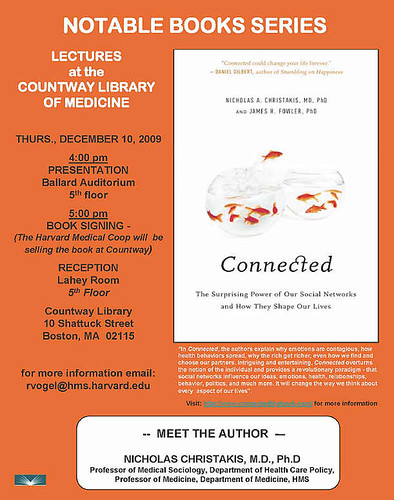
As part of our Notable Books series, Nicholas Christakis will be reviewing the interesting relationship between our social networks and disease burden (and related phenomena). This is in context of his recently published book:Connected: The Surprising Power of Our Social Networks and How They Shape Our Lives. Time: December 10th, 4pm. Place: Countway Library of Medicine, 5th floor, Ballard auditorium.
2009-11-13
Open Source Changing Medicine
Just as Open Access is a threat to an unsustainable publishing model, so it seems are open source medical applications to the most of the closed-source offerings of the for-profit sector. In conjunction with the development of substitutable platforms, there is a new and widening opportunity for independent developers to innovate and disseminate their solutions and to let a larger and more diverse ecosystem of solutions to be adopted. What is most promising in this regard is the growing acceptance of open source solutions for implementation
Addendum: It's rewarding to see our efforts listed here as among the top 10 open source software projects changing medicine (i2b2 and indivohealth).
2009-10-12
Where is the consumer in healthcare?
Prof. Regina Herzlinger, with the Harvard Business School, will be teaching a free intensive seminar course, Innovations in Consumer-Driven Health Care, in January 2010. This is a one week class, beginning on 1/11/10 and ending on 1/15/10.
She welcomes students from the various Harvard and MIT graduate schools as well as both undergraduate universities to submit their resumes to her for consideration if they wish to enroll . These can be to jlopez@hbs.edu. The class itself will be held on the Harvard Business School campus and will likely run from 9.00am until 3.30pm with a lunch period from 11.30am-1.00pm. Students chosen to take part in this class will be notified in November.
Innovations in Consumer-Driven Health Care
Monday, January 11-Friday, January 15; 9-11:30am and 1-3:30pm
Aldrich 211
Career Focus
Health care industry
Educational Objectives
This seminar will focus on the creation of innovations in health care that
better meet consumer needs.
Content and Organization
In the first two sessions on day one, students will examine three different
national models for achieving universal coverage:
* Consumer-driven health care in Switzerland, in which consumers use their
own funds to purchase insurance
* Single payer health care in the UK, in which the government controls the
health care system
* Managed competition system in the Netherlands, in which the government
creates a national health care market
On day two, the second two sessions will delineate the entrepreneurial
opportunities and obstacles created by a consumer-driven health care system.
On days three, four, and five, students will discuss case studies of
entrepreneurial, consumer-driven ventures in the following fields:
* Health insurance - innovative efforts that support health promotion and
reward efficiency (two cases)
* Health services - focused, integrated care for chronic diseases; specialty
hospitals; retail health care outlets; medical travel (four cases)
* Personalized diagnostics tests for mutated genes; companies that offer
genetic maps (two cases)
* Personalized medical devices - Proteous; Chronicle (two cases)
* Personalized drugs (one case)
* Personalized information (one case)
2009-06-17
When does an electronic medical record look like an iPhone?
Almost never. But it could be a lot more, as articulated by several of us who recently gathered at the Countway to discuss the matter.