Showing posts with label Noteworthy. Show all posts

2014-03-03

Scholar Medical Publication DIY by Harvard Medical Students


If, as F. Scott Fitzgerald is reported to have said, action is character, then the current crop of Harvard medical students are impressive characters. Amid all the din about who controls publication, open access and shortening the loop between academia  and public dissemination, a small group of determined individuals have just come out with their premiere issue of Harvard Medical Student Review. Considerable forethought, extensive deliberations with HMS leadership and creative talent have produced what is likely to become an authoritative voice for medical students and those interested in medical education and science.  In the words of the student publishers themselves:

Today we are introducing the Harvard Medical Student Review, an online journal that will serve as a forum for students to participate in the conversations on healthcare and medicine. Our classmates here and around the world come from innumerable backgrounds, rich in thought-provoking experiences; we have much to share. Topics may range from research to reflections on training and experiences with patients. We hope that through writing and reflection, we can spark productive debate, generate innovation, and learn from one another at the beginning of our professional education and careers.
As members of the medical community, we have a duty to review the facts and communicate the truth with clarity, precision, and humanity. In his address at the 2012 Harvard Medical School commencement ceremony, Dr. Don Berwick called upon new physicians to wield their voices proudly in carrying out this duty, as each voice “can be loud, and forceful, and confident, and will be trusted.” [2] The Harvard Medical Student Review is a space for students, trainees, and professionals to answer that call.
We hope you will join us.


2011-04-05

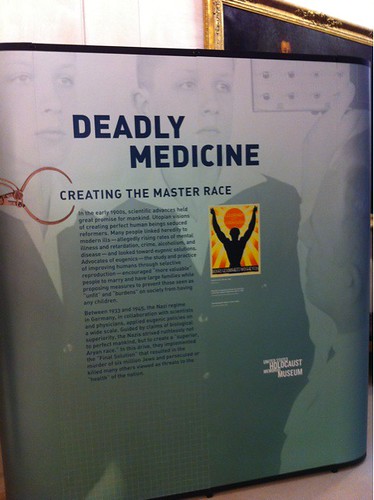
Deadly Medicine

We are hosting a sobering exhibit about what happens when medical science loses its moral compass. More details can be found here.

Back Of The Hill, Apr 5, 2011

2011-04-03

Write the Future

A very creative approach to impactful scholarship. Worth the try even if if fails.

Hat tip: Christopher Erdmann

2011-02-21

Hall or House of Mirrors? The citation perspective.

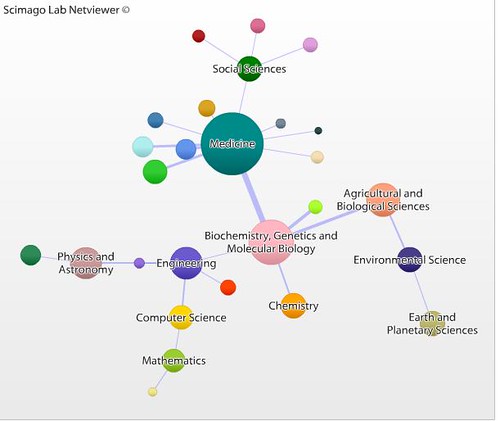
Kudos to the analysts at SCImago. They have provided an outstanding, entertaining and educational perspective on worldwide academic publishing. I'll focus here on only one aspect: citations. Although the United States is the leader in citations at 87M citations, it is a surprising laggard in self-citation (32% citations are self-citations). The leaders are China (62%), Lithuania (38%), and Iran (37%). However, in the domain of medicine, authors in the United States are considerably less reticent and rack up a self-citation rate of 47%, earning them second place. The map below of the subject areas of the USA publications indicates where the action is.

Hat tip: Peter Park

USA-publlications

2010-10-04

Holding our breath for this diabetes risk

A recent study exemplifies the leverage that can be obtained from mining existing, public data sets to further our national healthcare agenda. As described by the NY Times, our colleague John Brownstein obtained data from the Centers for Disease Control and Prevention (CDC) and U.S. Environmental Protection Agency (EPA) and found a consistent relationship between the amount of air pollution (particulate matter in the air) and population risk for diabetes (after correcting for the usual suspects such as income and ethnicity). This and other large-scale populations studies such as the one we recently reported by Atul Butte suggest that we might be insufficiently including the larger environment in our study of the diabetic plague that has afflicted us.

It also suggests that we have insufficiently taken advantage of freely available public data to pursue relevant and timely medical research.

2010-06-15

Let our data go

In principle we have access to our own healthcare data. In practice, it is frequently laborious, costly and at least inconvenient and sometimes impossible. In that context as noted by my colleague Keith Strier, we have some good news from the federal government.

In the very first PCHRI conference, when I facilitated the business section, one of the few truly memorable take-aways for me was coming to the conclusion that what we really needed was a “download” button on EHRs. It seemed so simple, but unachievable. Yet, here we are, the first major public initiative to install a download button. It’s nice to see if come full circle.

http://govhealthit.com/newsitem.aspx?nid=73961


Perhaps the government will mandate that all developers and vendors of electronic health records must follow suit.

2010-03-22

Free access app for open access content

We have just released a new iPhone application in collaboration with PloS Medicine and with the leadership of the Healthmap team (particularly John Brownstein) that allows you to read, browse and share content from PLoS Medicine including their features such as "collections". More to come in this vein from this and other knowledge sources in the near future.

2010-03-11

Making new the old

In this era of fungible electronic sources of data, there remain unique sources of scholarly materials developed in the course of the conduct of biomedical research. One of these is the Countway's Center for the History of Medicine (CHoM) which has just inaugurated its new electronic public face. There, you can learn which of CHoM's holding have been recently featured in the Smithsonian Magazine, a new initiative for digitizing rare books, or the availability of a new important collection.

2010-03-08

the new conditions of the Harvard Medical School promise to be as nearly ideal as the forethought of man can plan

or so it says in this 1905 article from Popular Science now available to all through the Popular Science archive viewer (courtesy of Google). Worth reading also for many wonderful quotes including "A medical student so trained [ in regularly reading selected up-to-date publications] in the use of medical literature can hardly be content to depend on antiquated text-book knowledge in his practise in after years." Amen. But do our students currently know how to (and have the culture) get up to date genetic and genomic relevant knowledge from the web? Perhaps our libraries can continue to lead in this regard.

Popsci1905

2010-02-21

What the Tell-Tale Heart Tells Us About Healthcare

At the end of his short story, Edgar Allen Poe's haunted murderous protagonist lets loose in front of the unsuspecting police officers:

"Villains!" I shrieked, "dissemble no more! I admit the deed! -- tear up the planks! -- here, here! -- it is the beating of his hideous heart!"

It is this story that inspired the title of a paper we published a few years ago on how we could detect the increase (and subsequent decrease) of myocardial infarctions coincident with the rise and fall of the use of Vioxx. This investigation relied solely on the informational byproducts of healthcare delivery. This weekend a Senate report on the risk of Avandia and what was known by GSK came to light. This resonated because we had recently published an article in Diabetes Care about the rapid identification of an increased risk of myocardial infarction with Avandia in patients with diabetes mellitus as compared to other drugs, even drugs in the same class, such as Pioglitazone. Whereas the current headlines are about what the pharmaceutical company knew or dissimulated, there is a broader question that needs addressing: Should every healthcare system not be instrumented so that the clinical leaders of these systems should know whether there are unexpected changes in the risks and health status of their patient populations?

Often, the state of clinical practice is compared unfavorably to the practice of commercial air travel, but what remains underemphasized is that as a system, we are flying blind. There is no local, regional or national air-traffic-controller-equivalent for the healthcare system. Should not the local hospital, and Department of Public Health be the first to know if there is about to be a local health collision or crash? Should not such local surveillance systems run in parallel to regional and national systems? Do we not need multi-level redundancy and open communication to avoid tens of thousands of unnecessary deaths? Further, even as the federal government becomes more aware of the need of such instrumentation, we all expect that our local healthcare systems and health authorities should know of any untoward health trends. Perhaps healthcare systems will start to compete on being able to provide timely and localized health trend data to their customers. Unfortunately right now, the major investments in such health market intelligence is to the payors (i.e. the insurers) who quite reasonably want to know what are the local risks, performance and trends for each of their contracts. Will it take regulation or market competition to make such data extraction and return to patients a matter of course? Let's hope we do not have to wait for a post-mortem Poe'esque orgy of recrimination to find out.

2009-11-24

When is obesity as infectious as tuberculosis (or even more)?

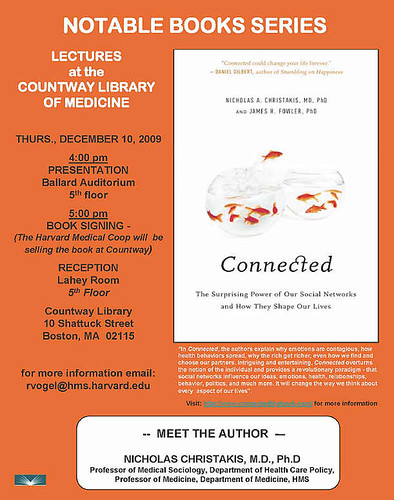
As part of our Notable Books series, Nicholas Christakis will be reviewing the interesting relationship between our social networks and disease burden (and related phenomena). This is in context of his recently published book:Connected: The Surprising Power of Our Social Networks and How They Shape Our Lives. Time: December 10th, 4pm. Place: Countway Library of Medicine, 5th floor, Ballard auditorium.


2009-10-26

Screening to distraction: Greater focus on the incidentalome

Last week, Gina Kolata of the New York Times summarized a growing controversy around the value of some of the types of medical screening tests currently employed.The salutory effect of this and related articles is a growing awareness of the tradeoff between increased sensitivity and specificity. It also is a shot across the bow as we contemplate the growth in the number of incidental findings that are going to occur as we test hundreds if not thousands of genetic variants today and in the future. Also, today, Gina Kolata reviewed how little we know about diseases as extensively studied as cancer. Some of them do disappear. Do these spontaneously regressed tumors contribute to the surprisingly high false positive rates for screening?

2009-10-23

A physician of distinction: Oliver Wendell Holmes

An invitation to celebrate the life, the accomplishments, and the continuing relevance of the literary and scientific contributions of Dr. Oliver Wendell Holmes.

Oliver Wendell Holmes (1809–1894)

Oliver Wendell Holmes (1809–1894) spent parts of the nineteenth century as America’s best-known physician and best-selling author. Sir William Osler praised him as “the most successful combination which the world has ever seen, of the physician and man of letters.” Henry James, Sr., called him “intellectually the most alive man I ever knew.” Today, he is remembered as a physician for his investigation of the contagiousness of puerperal fever (two decades before the advent of the germ theory), his advocacy for therapeutic skepticism and rationalism, and for coining such terms as “anesthesia.” He is celebrated as a literary and cultural figure for such poems as “Old Ironsides” (considered responsible for saving the U.S.S. Constitution), for his early forays into what would be considered a new depth psychology, and for terming Boston the “Hub of the solar system” and describing its “Brahmin” caste.

Join us to help celebrate the life, the accomplishments, and the continuing relevance of the literary and scientific contributions of Dr. Oliver Wendell Holmes.

Dr. Oliver Wendell Holmes and the Spirit of Skepticism:

November 17, 2009, 1:00 PM- 5:00 PM, reception 5:00-6:30

Location: Countway Library, 10 Shattuck St., Boston

2009-10-12

Where is the consumer in healthcare?

Prof. Regina Herzlinger, with the Harvard Business School, will be teaching a free intensive seminar course, Innovations in Consumer-Driven Health Care, in January 2010. This is a one week class, beginning on 1/11/10 and ending on 1/15/10.

She welcomes students from the various Harvard and MIT graduate schools as well as both undergraduate universities to submit their resumes to her for consideration if they wish to enroll . These can be to jlopez@hbs.edu. The class itself will be held on the Harvard Business School campus and will likely run from 9.00am until 3.30pm with a lunch period from 11.30am-1.00pm. Students chosen to take part in this class will be notified in November.

Innovations in Consumer-Driven Health Care

Monday, January 11-Friday, January 15; 9-11:30am and 1-3:30pm
Aldrich 211

Career Focus

Health care industry

Educational Objectives

This seminar will focus on the creation of innovations in health care that
better meet consumer needs.

Content and Organization

In the first two sessions on day one, students will examine three different
national models for achieving universal coverage:

*   Consumer-driven health care in Switzerland, in which consumers use their
own funds to purchase insurance
*   Single payer health care in the UK, in which the government controls the
health care system
*   Managed competition system in the Netherlands, in which the government
creates a national health care market

On day two, the second two sessions will delineate the entrepreneurial
opportunities and obstacles created by a consumer-driven health care system.

On days three, four, and five, students will discuss case studies of
entrepreneurial, consumer-driven ventures in the following fields:

*   Health insurance - innovative efforts that support health promotion and
reward efficiency (two cases)
*   Health services - focused, integrated care for chronic diseases; specialty
hospitals; retail health care outlets; medical travel (four cases)
*   Personalized diagnostics tests for mutated genes; companies that offer
genetic maps (two cases)
*   Personalized medical devices - Proteous; Chronicle (two cases)
*   Personalized drugs (one case)
*   Personalized information (one case)

2009-10-09

Not so knotty genomes

Erez Lieberman, of the HST Bioinformatics and Integrative Genomics program has just published a provocative paper which uses moderate resolution mapping (1 megabase) of the 3 dimensional structure of the genome. The results are consistent with prior work suggesting that DNA maintains its function by packaging itself into a structure that is free of knots. Now, if I could only apply this to my collection of wires in my drawer.

covermed-1

2009-08-26

2009-04-14

Doctors do not bill to make insurance companies smarter

Those of us who have worked with electronic healthcare data have been long aware of the limitations of billing data (aka claims data, aka administrative data) for research. They are often too coarse grained for clinical research and are inherently biased to maximize income. It is motivated by these limitations that Natural Language Processing (NLP) has become increasingly important in mining clinical records for research. What a doctor writes in her notes is much more revealing of her patient's state than what she bills for. Notwithstanding there are some significant challenges in the de-identification of textual records and in transforming these records into standardized clinical categories (e.g. SNOMED). Yet the appeal of using the clinical narrative text rather than claims data is compelling. In our work in i2b2, we have seen significant overrepresentation of diagnostic codes where a diagnostic encounter to "rule out" a disease was codified as that disease in the claims data. For example, a radiologist asked to rule out rheumatoid arthritis based on an X-ray will often classify the X-ray with a billing code corresponding to rheumatoid arthritis when perusal of the full narrative text of the radiologist's notes that there were NO findings consistent with rheumatoid arthritis.

A recent article in the Boston Globe points out additional challenges in using claims data for personal medical records. The same limitations of claims data for research appear to impinge on their utility for clinical care. My colleague John Halamka makes several useful suggestions on how to improve the use of such data, including recruiting patients themselves as collaborators in refining the categorization of their clinical records or even removing gross errors. Notwithstanding, a small number of codes are likely to be quite limiting and it may be that codifying the patient's record by using the entirety of their clinical documentation (i.e. what their care providers wrote about them) will ensure the most nuanced and most faithful representation available of what the clinician was thinking about in each clinical encounter with that patient.

2009-04-02

Medical Justice

One of the many reasons healthcare records do not have broad adoption, is that they are burdened with a multitude of functions beyond "merely" serving as a communications vehicle among the members of the healthcare team. All these functions are then bundled into monolithic systems by single vendors. It is then typically arduous and expensive to substitute new functionality for existing functions. Perhaps one of the most onerous uses of these systems, one that is not tightly linked to quality of care, is clinical documentation for preemptive legal defense rather than for effective clinical communication and decision making. This brief article in the NY Times offers a path towards safety and rationality so that patients who are injured are justly compensated and those who are not, are not compensated. It also offers as an implicit side-effect, changes in physician behavior and use of electronic medical record systems that would be focused on improving quality of care and communications (to and from patient as well as physician).