This comprehensive collection of DNA samples obtained from individuals arrested by an agent of a federal law enforcement agency will have several remarkable consequences. For example, if an information altruist, such as a volunteer for the Personal Genome Project, puts put on the web a substantial fraction of her genome, federal authorities will be able to trivially run a search program to see if any of them match the genomic characteristics of one of the previously arrested individuals. High-throughput genomics finally meets high-throughput forensics.


2008-04-02
Help for Public Access Submissions
Today we launched a series of NIH Public Access Policy pages on the Countway web site. This is the official web site for the university’s guidance on the NIH policy, which goes into effect on April 7, 2008. The site represents a collaboration with the university’s Office of the General Counsel, the university sponsored programs offices, and our very own staff. Special thanks are due to Alexa McCray for her leadership in this matter and to David Hummel, Scott Lapinski, Doug Macfadden, and Halip Saifi, for creating this terrific resource under enormous time pressure. Please take a look at the site (https://www.countway.harvard.edu/publicaccess) when you have a chance.
2008-03-31
What is the evidence?
This recent announcement of the lack of efficacy of a widely prescribed "cholesterol lowering" combination (two drugs) agent should give us pause. Those of us who practice medicine know all too well how much of what we do is art and not science. Despite billions of dollars of research that linked blood biomarkers such as LDL and CRP to heart disease, we now have a well-run trial that seems to show that the lowering of these "bad" biomarkers does not affect thickening of the walls of arteries in a manner previously thought to result in disease. This once again points to the importance of unimpeachable curation of medical evidence and its clear and untrammeled communication to patients and providers alike.
2008-03-27
No sound before its time?
This late breaking story about the recovery of the sound of a French recording, predating Edison's famous recording has relevance to our modern efforts in digital document archiving. Apparently, Edouard-Leon Scott was able to record sound but not in a way that his contemporaries could play back. It makes the point that archives that do not provide for an immediate "read out" can easily be lost to posterity even if they are physically durably accessible. This is the distinction between light and dark archives.
2008-03-23
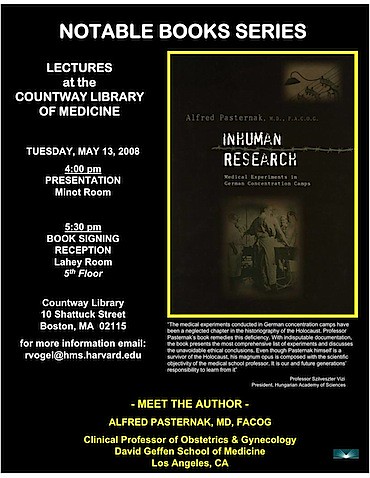
Notable Book: Inhuman Research, 5.13.08
Every year, we showcase 3-5 notable books. This one, written by Alfred Pasternak, I discovered through the outreach efforts of the Wiesenthal Museum for Tolerance in LA. Dr. Pasternak will be joining us on May 13th for a presentation at 4pm, followed by book signing. He will be accompanied by Ms. Liebe Geft, the director of the Museum of Tolerance, so I am quite sure it should make for a very interesting couple of hours.
2008-03-16
Large-scale extraction of gene-level physiology from the bibliome
If you have performed an expression microarray experiment, or a genome-wide association study, or a high-throughput proteomic experiment, you will have had a librarian moment. In that moment, you wish that someone would have organized all that had ever been written about the genes or segments of the genome that came up in your experiment as "significant," typically by some statistical measure. The alternative of having to read hundreds if not thousands of papers is unappealing. Because that librarian moment is so common in this genomic era, a slew of companies have emerged to provide a systematic annotation linked to the literature. In these endeavors, Their ambitions greatly surpass those of the ontologists who are "merely" satisfied with a a few labels for each gene regarding biological processes, functions and cellular locations and they seek to provide whole pathways of gene regulation, and signaling.
For this reason, I was quite intrigued by a presentation I recently heard at the C-SHALS conference in Cambridge, MA by a bioinformatics group at Sanofi Aventis. They provided that all too rare and extremely valuable style of review in biomedical science: The consumer report format. That is, they compared several of the leading bibliome-based gene annotation packages and systematically reviewed coverage and specificity of these competing wares. These products fell into two categories: those generated by human curation (Ingenuity, and GeneGO) and those by automated means (Temis, Ariadne). From my perspective the bottom-line was a) the coverage of all these packages is spotty and remarkably non-overlapping (of genes and processes) and b) the human-driven packages were dramatically better in several dimensions. Another full-time Librarian Employment Act, if librarians take this challenge of annotation as their own.
Technorati Tags: Informatics, Scholarship
Absence of a plan
Oya Rieger has produced a very useful and mercifully brief report for the Council on Library and Information Resources. She quickly brings us up to speed on the various large-scale digitization initiatives, reviews who the key players are and reveals, alas, that libraries are followers not leaders in these initiatives. Moreover, she also highlights the lack of a national plan for digital preservation and the myopic lack of coordination across libraries. Particularly revealing was the evidence of the sweeping aside of the meticulous but laborious curatorial plans concocted by librarians. In order to achieve the efficiencies required by the commercial partners who, of necessity, wished to measure success in years and not decades or centuries, These prior plans were greatly simplified and curatorial judgement replaced by broad and blunt heuristics. The report ends with a number of useful suggestions, many of which will require significant changes in the sociology of library stewardship.
Technorati Tags: archives, Collections, Open Access
2008-03-05
HMS Rewind: Harvard Medical School 1997
For those of us born before 1990, it may be hard to remember just how recent a development the web is. The Wayback Machine however provides a remarkable glimpse into how far we have come. Contrast this 1997 Harvard Medical School site with this one. Of course, if you are entering the class of 2011, the World Wide Web has always been an online tool. For these students, the preservation of digital content is taken for granted but with exceptions such as the Internet Archive (which depends on philanthropy and grants) huge tracts of this content are dissolving irretrievably.
Technorati Tags: archives, Collections, History, Scholarship
2008-03-03
Do we have enough informaticians?
It is generally agreed that we do not have enough informaticians. National organizations have posited that we need to have at least 10,000 informaticians by 2010. Other countries are investing heavily in such training. In Germany, for example, the number of graduates with degrees in informatics has doubled since 1997. But what are these informaticians supposed to know? Answering this question would go a long way to determining just who should be trained and for what purpose? Should they be able to answer these questions? Or should they be able to answer these? Further, should it be MDs that define the competence requirements or could it be nurses, or librarians? More to the point, why don't informaticians collaborate and share their expertise with individuals of other disciplines? And vice versa. For that matter, can informaticians of different stripes identify a common set of skills or is informatics going to balkanize into isolated sub-discplines? These questions point to the increased centrality of information sciences to the pursuit of clinical care and biomedical research and the resulting push to speciation to meet the varied needs of these biomedical constituencies.
Technorati Tags: academics, Informatics
Reference your open access articles for your NIH grants starting April 11th.
As per this NIH policy, all grants submitted after April 7th, 2008 should reference your open access articles. If you are faculty at HMS, the Countway Library will provide support for you to ensure that all the publications heretofore that result from NIH funded research will be available as open access articles.
Technorati Tags: academics, Open Access
2008-02-28
Electronic Medical Records: The Promise That Keeps on Promising
It has been well over 40 years since the vision of electronic medical records leading to greater efficiencies and quality of healthcare was articulated. It just goes to show that the problem was always much more difficult than anyone anticipated.
Technorati Tags: healthcare, Informatics
2008-02-19
Multilingual curation of worldwide outbreaks
A passenger who had taken a Greyhound bus ride to Calgary was found to have a case of tuberculosis and may have put the passengers at risk. He is currently being treated in a hospital. Also, there was a klebsiella pneumonia infection reported of a Swedish patient who had been on holiday in Greece. Further, on February 8th, there was a report of 13 cases of Botulism (one fatal) in the Tyumen Oblast region. The source of infection was apparently a homemade omul dish, prepared from fish that was ineffectively salted.
These are just three of hundreds of potential public health concerns reported worldwide through the Healthmap application. Since, I last looked at it, it has expanded its sources of information from ProMED mail and Google News to the WHO, Moreover Technologies, and Eurosurveillance. As before, all information is available through a Google map and it now includes Spanish, French, and Russian versions.
The result is one of the better examples of how a decentralized army of paid and unpaid rapporteurs can bring global health awareness to our public officials and to the public without requiring ponderous, extended and often unsuccessful setting of "standards" and standard operating procedures.
Technorati Tags: epidemiology, Informatics, Scholarship, Study design, world health
2008-02-18
Overcoming physical space limitations
Want to add more books to your library? Can't afford those compact shelving systems? Worry that the weight of books will defeat your building's structural limits and your staff's stamina? Fear no more, affordable library space is now available in SecondLife at several expanding libraries, including the consumer oriented InfoIsland. No need for stairs, no matter how many floors your library soars as your patrons can fly to any level they care to, no matter their age or physical abilities. Your holdings are safe, unaffected by the elements, available to any patron, until someone pulls the plug.
Technorati Tags: archives, Collections, consumer
2008-02-14
Open Access accounting?
Springer now provides a choice for authors to have their publication in any Springer journal appear as an open access article. As in many other open access journals, the author is charged a fee. In this case the fee is $3000 in addition to any usually author-borne publication costs. So, are the libraries gong to pay as much to Springer as before or does the additional funding reduce costs? Springer claims that it does. Is anyone willing to bet that costs will be less than the current costs plus inflation?
Technorati Tags: economics, Open Access
2008-02-12
The Case for Open Access
Robert Darnton, the Director of the Harvard University Library, states the case for open access. He also describes a policy that that has been assembled carefully, tirelessly, and with broad consultation in the Harvard community through the leadership of Stuart Shieber and Sid Verba.
Technorati Tags: academics, Open Access
2008-02-11
Accounting for Academics
"Publish and perish" has been successfully pursued by the hundreds of thousands leading to the sustained exponential growth of the bibliome. This growth in turn has created institutional stresses in creating balanced and standardized reviews of promotion cases and therefore we should not be surprised that there are now proposals to have a promotion process that is increasingly bibliometrically driven despite a rearguard action. Will our academic rank equal our pagerank in 20 years?
Technorati Tags: academics, Scholarship
2008-02-10
Archival black hole
This article does a very nice job of addressing the challenge of archiving electronic correspondence. Whereas I can go to L2 and see the notes of Joseph Murray as he prepared to perform the first successful transplant between homozygous twins, I know that I am not going to be able to find the correspondence describing equally important findings of the last twenty years. Why? Because we are not systematically archiving the electronic mail of our scholars. This is a classical example of where perfect is the enemy of good. There are myriad issues that have to be addressed if all such correspondence is to be stored and retrieved on demand. However, a few compromises make the task much simpler. I will review these in future entries but have no illusion, the libraries of today are almost all falling down on this job. A hundred years from now, historians will wonder why they can learn more about biomedical research, up close and personal, in the 1950's than in the archival black hole of 1990-2010.
2008-02-05
Modern perspective on contagion.
On January 31, Harvard's Open Collections Program (OCP) launched its third online collection, Contagion: Historical Views of Diseases and Epidemics. The new, web-accessible collection is online now. The Countway's collections are heavily featured. More to come. In an era anticipating global pandemics, this collection is all too relevant.
Technorati Tags: Collections, healthcare, History, Scholarship
2008-02-03
Autonomy and guardianship of our own clinical information.
In 1999 I had an inspiring conversation with one of my more brilliant colleagues, Dr. David Margulies. David was floating the idea of creating a commercial ecosystem whereby there was just in time bidding over the Internet for different service package for patient care. The nature of such packages would range from such well-established services as home visiting nurses but would extend to the cost of supplies for surgical procedures to entire disease management package for instance, lifetime diabetes care. In doing so David presciently was combining what would become in 3-5 years known as Web 2.0 technologies and some free market principles to argue that such an open market would create such efficiencies that would both lower health care costs and encourage standardization and improved quality of the products of health care delivery. Although the company founded around this idea, SmartAgents (with which I never had any relationship), was eventually acquired by a larger company, it is not clear to me that any of these ideas ever came to their full fruitition. From this admittedly biased perspective, it is because yet again the buyers of the product, the recipients of the product and the payers of the product were, as they have been for a long time in health care, been poorly aligned.
Market efficiencies will make the most sense when patients will have transparent access to the relative costs and qualities of packages afforded to them at the time they purchase entire health care packages such as insurance so that an efficient market will have appropriate feedback mechanism in terms of the consumer of that product. However, with all the complicated details required of such a system, the sine qua non precondition will be portable transparent access to patient information under patient control so that for a given state of disclosure, a vendor of a particular health care good can efficiently and accurately bid to provide that care. Let’s be clear we are not asking patients literally out the door with their leg in a cast to put out on a medical “eBay” request for bids for their after surgical care. In directly identifying the patient and their patient controlled record as the conduit for decision-making on who has access to their information and who gets to bid on which services to their healthcare professionals (or other decision makers) we are putting the real payors in charge. And we, the patients can decided whether the payment system we adopt is one of full payment, partial payment and so on. We can decide to bid for services through collectives such as patient advocacy groups, employers or even hospitals but the decision is ours. This may seem a little too coolly rational and heartless (or naively optimistic about individual autonomy) but let’s contrast that to the current system where the patient is not a party at all to the bidding for healthcare products, they have no knowledge of whether the best such package was selected for them or the cheapest package. They have furthermore no idea to what extent they are in a long term, short term or committed relationship with these vendors or products.
By revisiting the maxim “she who controls information exerts control” through the use of personally controlled records we are re-asserting or perhaps asserting for the very first time the patient’s fundamental control of the market around their services. Again, this does not mitigate the need for collective bargaining for healthcare services, nor does it remove expert decision makers from decisions regarding, which packages of health care are in the best interest of the patients. It does however provide transparency to the patient and a rational basis for them to decide whether they are getting, in their opinion, value for their money or whether should they seek such value elsewhere. This is no more (unfortunately) and no less than the cellular phone companies provide us all when they attempt to woo us to adopting one of their service plans. The much larger stakes of health care makes such transparency more, not less necessary. Given my recent experiences with my cell phone (and my mother's health insurance invoices), I do hope we end up with more transparency.
Technorati Tags: consumer, economics, healthcare, Informatics
2008-02-01
Copyright and open access.
The ecosystem of rights and copyrighting biomedical publications is about to be disrupted by a very important and useful piece of legislation. To this point, this interesting webcast by Matthew Schruers is very likely to be of interest.
Technorati Tags: Open Access, Scholarship
Subscribe to:
Posts (Atom)